I left India for the first time and landed in Melbourne, Australia on the 4th January 1979. It was a hot as hell summer. My first impressions of Down Under: I saw strangely dressed people walking in the airport. Men in shorts with long stockings and shoes and collared shirts with ties. I was soon to learn that Melbourne was a city of four seasons-a-day. If it was hot now, an hour later it could rain. Then the sun would shine and the cool breeze of the Dandenong Ranges would make you shiver in the evening. All in one day.
The office of Price Waterhouse was in the National Mutual Centre in Collins Street. There, I met my host manager Paul Brasher. He was a tall, blond, handsome young man. He briefed me and then took me to god: Norman Stevens, who was my host partner. He was also the national Human Resources Chief. Since it was the first time that the Australian and Indian firm were collaborating to roll out a two-year exchange program, both sides wanted to over-manage to get it right.
Norm Stevens was a soft-spoken person. He was a bachelor and a senior audit partner who managed the Royal Dutch Shell account. He was one of the few partners who sat in a corner office with old-fashioned wooden panels and a thick polished wooden door.
Next week I was assigned to a project. It was with a family-owned company managed by a patriarch who was the founder. The project codename was Thunderbolt. The CEO of the company, who was an outside professional, had siphoned funds and our firm was brought in to conduct an investigation. Nowadays you have a nice name for it: forensics and large global firms like Deloitte and PwC have hundreds of partners and staff dedicated to their forensics practice. Back then, we called it by its plain name: fraud investigation. My resume disclosed that I had spent a year conducting fraud investigations in India. In addition, I was not an Australian and my supervisors felt that this would add an extra layer of confidentiality.
My manager on the job was Frank Ensabella who had migrated from the city of Catania in Sicily. He was short and portly, with patches of dark hair and his whole body shook uncontrollably when he laughed at his own jokes which was often. He had spent two years in Indonesia. Paul Brasher believed that this experience qualified him to be culturally attuned to manage a new member who had arrived from India because there was no Manager who had a real India experience.
Frank told me that the CEO had an affair with a rather expensive fashion model and he had found ways to siphon funds from the company. Our task was to find out how much and in what way. We set about to do our work. In my past experience with fraud investigations, I have found that the best technique was to win the trust of one or two insiders who were willing to tell you the modus operandi, provided you could assure them, with some credibility, that they would not be sacrificed in a witch hunt. Usually, they were unwilling accomplices who have a troubled conscience and who are fearful of action by the management and law enforcement authorities.
It took me a little time to identify such a person but I was lucky to find one. I stumbled upon his signatures on vouchers that looked suspect and I told him that if he did not come clean, there would be serious problems. If, however, he chose to cooperate with me, I would talk to the management on his behalf. The guy had migrated from the then Yugoslavia, with a young family and had been coerced by the crooked CEO to approve and pay dubious entities. When I was questioning him I saw fear in his eyes and beads of sweat on his eyebrows. I politely nodded while he provided explanations, leaving him in no doubt that I did not believe him.
After two days, he agreed to cooperate and Frank and I spoke to the owner of the business and sought his approval. The guy sang like a canary and we had our report wrapped up in two weeks. The presentation was made with the help of a slide projector.
After the presentation, the owner of the company Mr.E.E.Goldhammer wanted to see me. When I went to his office he told me that he was impressed with my integrity and my ability to ferret out the frauds and would I consider taking up a job in his company? He offered a much higher compensation and he promised to apply for my permanent residence. I thanked him and told him it was a rare privilege to work for him as a client but I was determined to go back to my own country and leaving Price Waterhouse was farthest from my mind.
I reported the matter to Paul Brasher who was delighted that I had said no and said, “You are a very good ambassador of the Indian firm”. For the 18 months that I spent in Melbourne I was trained in what was then known as EDP auditing. To augment my knowledge, I went to classes at Prahran College of Technology in the evenings. Paul was my mentor and host manager throughout my stay.
On Friday evenings, we used to go to the Old London pub across the street for beer. There I met a maverick tax manager called John Harvey who resembled John Lennon. He had long hair and round glasses. He dressed differently and thought like a maverick. Since I had worked in tax in India I could converse with him intelligibly.
Among the managers, the gossip was that both John Harvey and Paul Brasher were fierce competitors. Both would go up a long way in the hierarchy of Price Waterhouse. I was obviously a fan of Paul. Paul was a bright all-rounder, a great communicator and very much a people’s man. He had hardly any critics among his peers, his juniors or his partners. John was considered a brilliant tax-planner and a master strategist. But both had one common challenge. They were from Melbourne. Sydney, on the other hand, was a much larger office and traditionally the CEO was picked from Sydney office, which always had more partners than Melbourne.
On the last week of my stay in Australia, Norm Stevens and Paul Brasher invited me to a farewell lunch at an Indian restaurant called Phantom India. I think it was in Swanson Street, not far from our office. We had some reasonably hot curries and rice with Victoria Bitter (beer) and my Aussie hosts were at the tipping point of their spice threshold.
At the end of the lunch, they presented me with a pen with my name engraved on it and Paul said, “Norm wants you to sign your first accounts with this pen when you become a partner.” Those who know anything about a global accounting firm are aware that admission to partnership is the most unpredictable and difficult point in the career of any professional. But Paul and Norm proved right. They provided me with the confidence and courage and I became the youngest partner of Price Waterhouse in India and signed my first opinion with the pen gifted by them on 7th August 1984.
Before leaving Australia, I had told Paul Brasher that I was confident that he would certainly go up in life and become the CEO of Price Waterhouse, Australia. I was partly right and partly wrong. John Harvey pipped Paul for the position of CEO in 1996 and held the position for one term. Paul Brasher became the Chairman of Price Waterhouse, Australia. But he did not stop there. He went on to became the Chairman of the Global firm of PricewaterhouseCoopers. I met him last in 2006 during the Asian Games in Melbourne and talked about old times. The Chairman of a $30 billion global organization talked to me like the young manager I knew almost three decades ago.
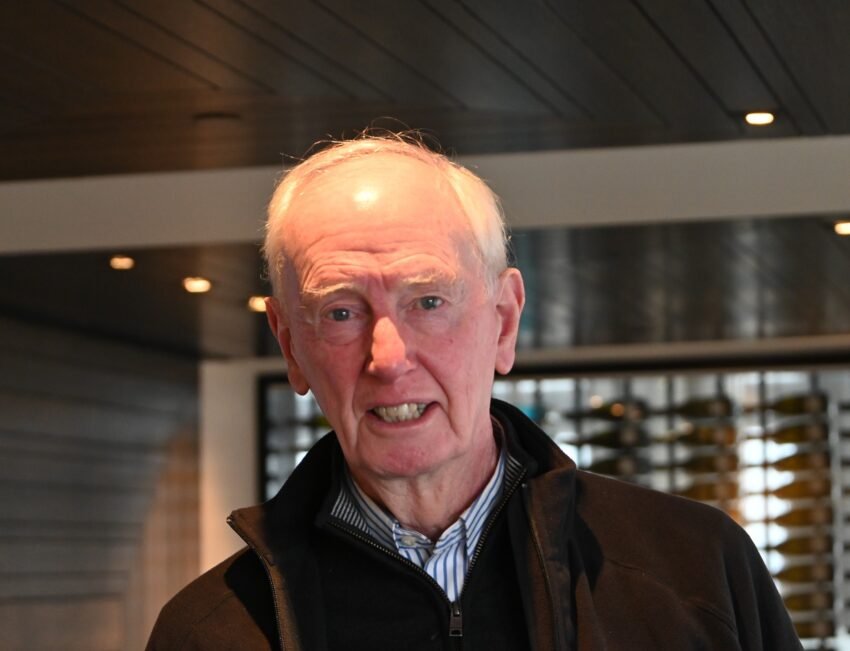
My mentor from Down Under: Paul Brasher
Category: Business