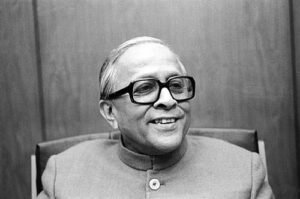
In 1994, Shishir Bajoria became the President of the Indian Chamber of Commerce. Shishir’s brother Mahendra was my classmate in school and their father Late B P Bajoria had a particular fondness for me.
The winds of liberalization, which began with the dismantling of the license raj on 24th July 1991, was gaining gale force in 1994. Global companies were all looking at India again as a destination for investments.
While states like Maharashtra, Gujarat and Tamil Nadu were inviting foreign capital successfully, West Bengal was slipping in the pecking order. The Chief Minister of the state Jyoti Basu was a communist. The US and UK looked upon communists with great suspicion. The Communists had not helped matters by naming Harrington Street, where the US consulate was located, as Ho Chi Minh Sarani -a slap in the face of the US government. The Left Front government contributed the term “gherao” to the Oxford English Dictionary (OED). It was a noun which according to the OED meant “a protest in which workers prevent employers leaving a place of work until certain demands are met.” In several cases force was used to confine the employers without food or the use of toilets. This practice was later held to be illegal by courts of law. Multinational companies (MNCs) were leaving West Bengal and no new foreign investments were coming in.
Jyoti Basu was a trade union leader and communist alright but he was also a British-trained barrister. His spoken and written English were better than his mother tongue. He loved to return to London for his vacations in summer and was pragmatic enough to realize that if investments dried up, the youth unemployment would be a serious challenge.
Shishir’s family had bought Mcleod Group, a managing agency house from the British. This group owned a tea company which in turn owned a sprawling bungalow with manicured lawns at 7 Alipore Road, Calcutta. This turned to be a critical piece of the puzzle. Mike Waller, who had the responsibility for oversight of the Indian practice of Price Waterhouse on behalf of Price Waterhouse World Firm (PWWF) was born in this very house. His father was a Visiting Agent of the Mcleod Group tea companies. Mike liked coming back to Calcutta and he used to tell me how as a “chokra boy” (young lad) he learnt to play golf at the Tolly.
One evening, Shishir and I sat down to discuss what could be done to improve the image of West Bengal as a destination of foreign investments. Shishir came up with the idea of taking a delegation of Indian industrialists to London. Nowadays numerous delegations go to all sorts of countries but in 1994 it was a revolutionary idea. As we brainstormed along with ICC’s brilliant Secretary-General Nazeeb Arif , it dawned on us that by taking a delegation of Indian industrialists to the UK or US there would be little impact. We needed UK CEOs to come to our meeting. Why would they come to a meeting of a chamber of commerce from India? What would be the draw? What if Chief Minister Jyoti Basu led a high-level delegation and Price Waterhouse London hosted a lunch for the CEOs of the leading UK companies? We all agreed that would work.
I called Mike Waller and asked him if he would be willing to organize and fund a lunch in London. I also told him that the Indian Chamber of Commerce was being led by Shishir Bajoria whom he knew well as BP’s son. Shishir also spoke to him directly. Mike agreed with a condition that the lunch would be organized in the London head-quarters of Price Waterhouse in Southwark Towers which stood above the London Bridge underground station. I say “stood”, because it no longer exists.
I knew that in the building which Price Waterhouse owned, there was an entire floor with excellent dining and catering facilities that matched or exceeded the standards of a good hotel. Besides, PW had, what was then, state-of-the-art meeting and presentation facilities. We agreed.
Shishir and I brain-stormed again and he suggested that Price Waterhouse should prepare a strategy document for investments in West Bengal and we should take printed copies with us for Price Waterhouse to make a brief presentation. As we kept analysing the approach, it became clear to us that while a strategy document would a useful guidance to the West Bengal government, it would be of little interest to the UK CEOs.
Finally, we agreed to create a document called Doing Business in West Bengal which would be a crisp, glossy document in two parts. The first part would explain in very simple terms the implication of India’s new policies and what sectors would be attractive for UK investors in West Bengal. The second part would have a full page interview of CEOs of foreign companies which were doing business in West Bengal. Because Price Waterhouse would sign off on the document and would bear its brand, we insisted that no editing or tweaking of the interview should be permitted. There were 12 interviews in all. It was agreed that PW would do the work pro bono i.e. charge no fees but the costs of printing and designing would be met by the ICC and WBIDC, whose Chairman Somnath Chatterjee agreed to support us with his team.
The next logical step was to convince the Chief Minister. It was huge step for a communist Chief Minister to go to an “imperialist” country and meet chieftains of capitalism and seek their support. What would the party say? It was not a slam dunk that he would agree. The Chief Minister was a personal friend of my father and he had seen me grow up as a child. He knew Shishir well and most importantly he was a great pragmatist and not an ideologue. He agreed to go with one condition. He insisted that wherever we describe his government’s policy we should specifically write that his government is seeking investments “on mutually beneficial terms”. Later those words were enshrined in the industrial policy.
We encountered two other minor bumps on the way. The first was a statement by Mr S.S. Prasad, the Managing Director of British Oxygen Company(BOC), India. He said in his interview that he had rationalized his work-force in West Bengal and had not faced any unreasonable opposition from the government. One government official felt if this boast was included in a public domain document, it could be embarrassing for the Left Front government.
We declined to edit the passage and argued that this would have a positive impact on the business leaders in the UK. The second was the cover-page photo of the document: would it be the old Howrah Bridge on the River Hooghly or would it be a photograph of the “colonial” Victoria Memorial at night illuminated by the new lighting system funded by Tata Steel? We decided on the latter and much to our delight the West Bengal government agreed on “aesthetic grounds”.
Finally, the lunch and the presentation went well. As was expected, Chief Minister Jyoti Basu spoke immaculate English and charmed the CEOs of very large UK companies. The London partners of Price Waterhouse ,who spoke to me privately and in confidence, were genuinely impressed by Chief Minister Basu and his pragmatic and business-friendly approach.
Following the lunch, there was a Press conference in which the politician in the Chief Minister came out. He responded to each question with pragmatism and political correctness until it was time for the correspondent BBC Bangla to ask the last question. He asked, “Who would you thank for the new winds of business opportunities blowing in West Bengal.” The comrade in Jyoti Basu would not give an inch to his political rivals Prime Minister Narasimha Rao or the Finance Minister Manmohan Singh. He said, “Who will I thank? The circumstances, of course.”