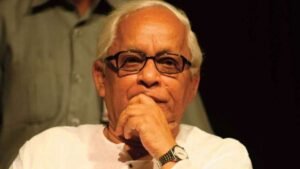
Buddhadeb Bhattacharjee became the Chief Minister of West Bengal on 6th November 2000 when Jyoti Basu stepped down. The transition was well- orchestrated. The younger party leaders were worried that Jyoti Basu was not only saddled with the problems of incumbency, there were also allegations of nepotism. Because strikes and flight of capital, the industrial scene of West Bengal was gloomy and needed a make-over.
The Party’s strategy was to field a new, unblemished face with an’incorruptible’ image. They decided on Buddhadeb Bhattacharjee. Under his leadership, the Left Front won a record 6th term in West Bengal in May 2001, though with a much reduced majority.
After I joined the Executive Council of Nasscom in 2002, I was frequently in contact with the Chief Minister. He was keen to develop and expand the IT Services industry in Salt Lake. He consulted Som Mittal, Kiran Karnik and me from Nasscom for suggestions. Nasscom provided him with a number of suggestions. One of them was to exempt the IT services industry from general strikes. Today, it might seem an easy decision for a 7 by 24 industry but at the time it was not. Buddhababu was not just the Chief Minister of West Bengal, he was also a member of the Politburo of his party which called and supported the general strikes called bandhs.
We were asked to present to the CITU leaders why Bengal would be impacted adversely if we disrupted work in a continuous and uninterruptible industry. We explained to the CITU leaders the nature of the 7 by 24 beast. An offshore software factory was based on the premise that telecommunications make the engineers electronically portable. Just as the jobs have travelled to Calcutta by the flick of a switch, the jobs can go to Hyderabad or Bangalore by another flick of a switch, if work was disrupted by bandhs.
Most of the CITU leaders present in the room were reasonable and intelligent people. I was pleasantly surprised that a noted CITU leader known for his impeccable integrity had a daughter working in a software company and he grasped the problem thoroughly and was in agreement with our proposal. But one particular leader was difficult. He posed the question, “Are the IT services employees princes (rajputras) that they will receive such special treatment?”
I could not resist the temptation of whacking his lose ball to the fence. I said, “You are a party of proletarians. To you the Princes are the feudal class to whom no preferred treatment should be offered. Am I hearing you right?” Everyone in the room laughed and we hammered out a deal which was widely covered by the media. I am sure behind closed door the Chief Minister threw in his weight.
Buddhababu sincerely believed that unless there was rapid and large-scale industrialization of West Bengal, employment opportunities in West Bengal would shrink and we would face a demographic nightmare with young people without jobs or other gainful occupations resulting in social turmoil, extortion and unrest. He took a number of policy initiatives to accelerate industrialization and to create employment opportunities in the state.
First, he wanted FDI to come into the manufacturing sector and to this end he visited Singapore, Indonesia and Vietnam. I was privileged to join as a member of his official delegation. He did not pursue the now-discarded BJP mantra of “Computer Chips yes, Potato Chips No” which really made no sense at all. Ironically, the largest potato chips factory of Frito Lays of Pepsi is in Bengal. Second, his government worked with the British Government’s financial aid arm DFID to “restructure” about 20 stressed and sick companies in Bengal either to revive them or to sell them to companies which could cause a turnaround. A classic example was the Great Eastern Hotel. The third strategy was to persuade domestic industrialists to set up large-scale manufacturing facilities in the state. The Tata Nano factory and the Jindal Steel were part of that grand vision. The fourth pillar was to improve the relationship with the Central Government and encourage them to expand PSU units in the state-SAIL (Burnpur and Durgapur expansions) and NTPC units were fruits of this strategy. The fifth plank was to urge the Centre to improve infrastructure in the form of urban transportation, private airports and a deep-sea port. While the metro expansion is underway and a private airport is limping, the deep-sea port is still on the drawing board.
Our trip to Singapore was well-organized. Apart from meeting various organizations in Singapore, the highlight of the trip was a dinner with the CEOs of large Singapore companies. I had requested Gautam Banerjee, who was then the CEO of PwC Singapore, to sponsor and organize this event. Gautam appropriately chose the East India Room of the iconic Raffles Hotel as the venue of the meeting. It was attended by about 50 CEOs from the largest companies in Singapore. PwC India and Singapore collaborated with WBIDC to make a crisp presentation and, thereafter, the Chief Minister interacted with the CEOs in a Town Hall format. When we checked back with the CEOs, they were particularly impressed with the opportunity of interacting with the Chief Minister directly . CEOs everywhere hate choreographed presentations.
Our visits to Indonesia was more high-key. At the time, the Salim Group was planning to make huge investments in a Petrochemical Complex in the state. The Ciputra and Salim Group were also investing in Kolkata West International City on the Howrah-Amta Road. The person who was liaising between the state government and the Indonesian investors was a NRI called Prasoon Mukherjee who had a company called Universal Success. He was once a Food and Beverages manager of the PSU hotel Ashoka in Delhi and had migrated to Indonesia in search of fortune. In Indonesia, I discovered he owned a fast-food chain called Outback Steakhouse where he took the delegation to dinner.
There were intense interactions with Indonesian investors who were looking for opportunities to invest in India. I was particularly impressed with Anthony Salim. Contrary to rumours then swirling in Kolkata, Salim was a prominent businessman in Indonesia. I checked with PricewaterhouseCoopers Indonesia and they confirmed that Salim Group was the largest conglomerate in the country. There was a lot of disinformation in the vernacular press in Kolkata about Salim being a nephew of Suharto. I discovered that Anthony Salim’s father was not even a bumiputra. He was an immigrant from Fuzhou province in China. Anthony’s real name was Liem Hong Sien. He followed the Christian religion but his “business name” was Anthony Salim.
I was fortunate to be present in the small meeting in a hotel in Jakarta where Buddhadeb met Salim. Salim was then gung-ho about business prospects in Bengal and assured his personal commitment to the decisions being taken by his group. While the conflagration in the Singur Nano factory of the Tatas is considered to be the reason for the downfall of the government, the Nandigram fiasco was also a key contributor. The Salim Group’s petrochemical complex was planned in Nandigram.
In May 2011, the Trinamool (Grassroots) Congress Party led by Sm. Mamata Banerjee defeated the Left Front and Buddhadeb himself lost his seat in Jadavpur, a constituency he had represented for an unbroken period of 24 years. His successor reversed the land acquisition policy and scrapped the IT SEZs he had announced. But she has continued the policy of attracting FDI to Bengal and I have participated in her delegations as well.
Everyone today acknowledges that the agriculture and services sectors will not create the massive job creation required to solve the unemployment and labour migration problems of Bengal. It is too early to assess objectively Buddhadeb’s role in the history of modern Bengal as views are sharply polarized. But one lesson stands out. In politics, policies and reforms cannot be implemented without creating a massive awareness, change management and support of the people. A philosopher king, who is unable galvanize the masses at the grassroots, does not succeed in bringing about meaningful social and economic transformation.