The elixir of life
High Tea, India Style
Jehad Nga for The New York Times
By MATT GROSS
Published: October 14, 2007
THE Himalayas rose almost out of nowhere. One minute the Maruti Suzuki hatchback was cruising the humid plains of West Bengal, palm trees and clouds obscuring the hills to come; the next it was navigating a decrepit road that squiggled up through forests of cypress and bamboo. The taxi wheezed with the strain of the slopes, and the driver honked to alert unseen vehicles to our presence — one miscalculation, one near miss, could send the little car over the edge and down thousands of feet, returning us to the plains below in a matter of seconds.
The Himalayas
Breakfast had just begun, a fabulous spread of fresh-baked croissants with pomelo marmalade, a spicy Parsi scrambled egg dish, bacon, sausage, papaya, custard apple, orange juice. … I sat down among the other guests, a mix of 10 Indians, Britons and Americans, and gorged in bliss.
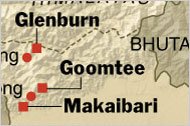
The man responsible for Glenburn’s tea was Sanjay Sharma, 33, whose self-satisfied smile suggested he was well on his way to developing a Rajah-size ego. And perhaps with good reason — at 28, he was appointed estate manager, the youngest ever in Darjeeling, he said. He has tried to push the production in new directions, and he asserted that Glenburn now ranked No. 17 in the district.
In my limited experience, it could have been No. 2 after Makaibari. Mr. Sharma’s first-flush teas had that wonderful flowery scent and a long, lingering aftertaste, with just a hint of bite.
Alas, Glenburn was booked, so I endured the jackhammer trip back to Darjeeling, consoled by a single thought: soon, I’d be checking into Goomtee, a resort recommended by Nathmull’s, the best tea shop in Darjeeling.
In terms of luxury, Goomtee stood somewhere between Makaibari and Glenburn. The comfy planter’s house recalled 1950 rather than 1850, with huge rooms and a garden of azaleas in purplish bloom, and since the owners of the cypress-dotted estate were strict vegetarians, so were the guests — myself and four Japanese women from a tea-appreciation society. After checking in and getting a traditional welcome dollop of green-tinted rice pressed to my forehead, I followed them and their translator to the fields.
And I began to fade. Maybe it was that I’d seen too many tea bushes, maybe that I couldn’t understand Japanese, maybe that later I once again found myself waiting in the office of another estate manager, wondering if I’d ever get a taste of his leaves.
I was about to drop off entirely when an assistant brought in a full tea service and poured us each a cup. I sipped. This is what they mean by “brisk,” a bright flavor that fills your mouth and wakes you right up.
“Oishii!” the women cooed. “So tasty!”
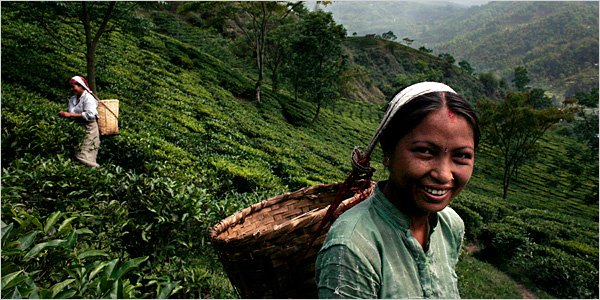
I soon learned more about briskness, when I set off one morning for Muscatel Valley, Goomtee’s far-flung organic fields. It was a more serious hike than I’d expected, about four and a half miles up narrow, rocky paths that eventually led to an awe-inspiring landscape.
If Makaibari had been wild and Glenburn a fantasyland, then Muscatel Valley was positively prehistoric, with massive stone outcroppings amid lonely fields of tea bushes stretching into the Jurassic distance. Sunlit mist shrouded the far mountains, and all traces of civilization vanished. There was nothing but me and the tea.
When I returned to my room, I flopped down in exhaustion. It wasn’t the hike, though: I was tea’d out.
How, I wondered, could these professionals differentiate among the infinitely subtle gradations of flavor and scent? What stuck in my mind was the tea-ness of tea, floral aroma, hints of fruit and wood on the palate, and a fragile astringency that buzzed in my mouth long after the liquid had gone down. But which cup had that been, the Makaibari or the Glenburn? Or had I just imagined it?
A day later, on a slow Internet connection, I received an instant message from a friend in New York: Could I bring her some first flush?
“It’s for a dear friend from Darjeeling,” she wrote. “He’s dying, and he hasn’t lived in India for more than 60 years, but he still dreams about the tea.”
I had a mission. On my way home, I bought a wooden box of Makaibari’s first flush and delivered it to my friend soon after my return. A few weeks later, she forwarded me her 97-year-old friend’s thank-you e-mail note.
“It was so precious,” he wrote, “that I shared part of it with the Namgyal Monastery” in Ithaca, N.Y. The “beautiful little casket” of tea now sits at the feet of the monastery’s Buddha, he added, and “in the major pujas to come, it is your gift that will be brewed.”
Prayer ceremonies in the Finger Lakes, I thought: a fitting end for this tiny box of fragrant leaves. Namaste to that.